Can you be a Christian and struggle with mental health?

Before I dive into today’s post, I want to let you know that this blog is a safe space for anyone who is struggling or feeling isolated in their journey. Whether you’re dealing with mental health challenges, chronic illness, or just trying to navigate your faith in a difficult season of life, you’re not alone. This series is going to explore hard truths, share stories, and hopefully encourage you in a real, relatable way.

So, lets jump in!

It’s common in many faith communities to hear well-meaning phrases like, “If you just pray more, you’ll be healed,” or “Faith will fix this.” But, what happens when healing comes right away, or when the struggles feel too big for just prayer alone? Is there something wrong with your faith if you’re still battling anxiety, depression, or other mental health challenges?

I can’t speak for everyone, but I know I’ve struggled with this question. Growing up as a Christian, I have felt guilty for feeling anxious or depressed, as though it meant I wasn’t praying enough, or that somehow my relationship with God was lacking. But the truth is, struggling with mental health doesn’t mean we lack faith. Mental health issues don’t discriminate – they can affect anyone, no matter how strong their faith may be. It’s a misconception that if you’re truly trusting God, you won’t struggle with things like depression, anxiety, or even feeling overwhelmed by life. Struggling does not mean failing.

So, where does that leave us?

When we look at the Bible, we see that mental health struggles are acknowledged throughout Scripture. Even some of the greatest figures of faith faced dark, difficult times. The Psalms are full of David’s cries of despair – his deep sadness and his feelings of abandonment. Take Psalm 42, for example: “Why, my soul, are you downcast? Why so disturbed within me? Put your hope in God, for I will yet praise him, my Saviour and my God.”

David was honest with God about how he felt. And I believe God honoured that honesty. He doesn’t expect us to put on a mask and pretend that everything’s okay when it’s not.

And here’s the tricky part: many of us grow up with an idea that if we’re struggling, it’s because we’re not praying enough, or that God is punishing us for something. We see others who seem to have it all together – who are calm, confident, and free from anxiety – and we thing, “Well, what’s wrong with me?” And the guilt and shame can grow, making it even harder to seek help.

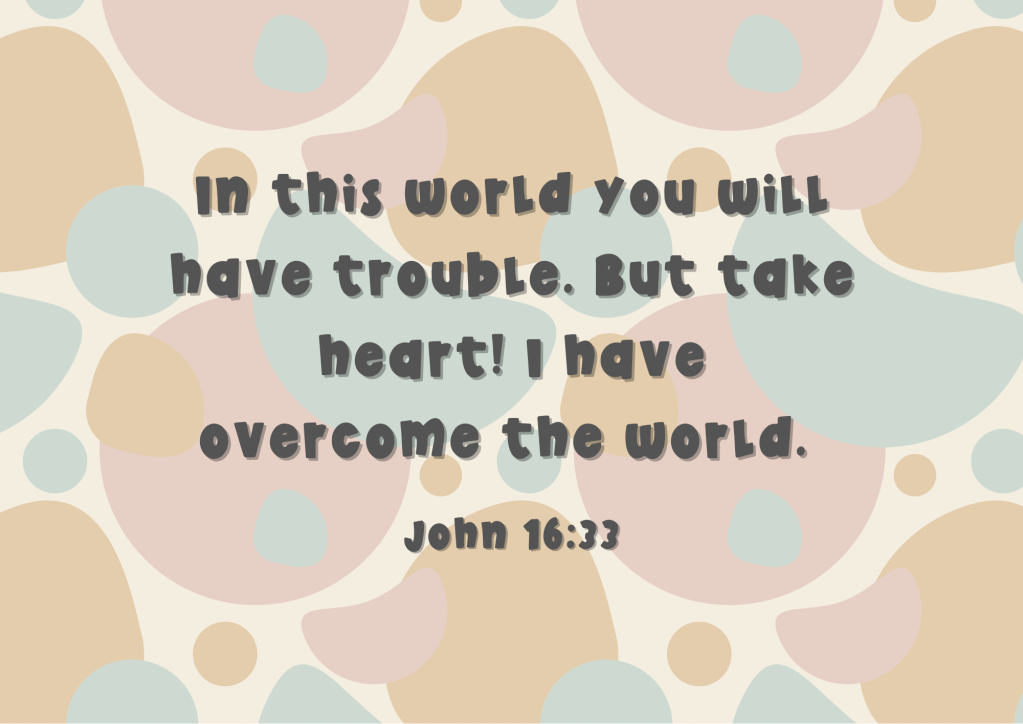
It’s that mindset that I want to challenge today. The truth is, just because we have faith doesn’t mean we won’t face challenges. Jesus himself said, “In this world you will have trouble. But take heart! I have overcome the world.” (John 16:33) That verse doesn’t say “If you have enough faith, you won’t face difficulty.” It says that, even in the midst of difficulty, we can take heart because Jesus has overcome it all. He’s with us in our pain, our struggles, and our doubts.

And that’s something that’s been something so powerful in my own journey: understanding that God is with me in the struggle. He doesn’t leave us when we’re struggling mentally or emotionally. I’ve learned that struggling with mental health doesn’t mean we’re failing God or our faith – it means we’re human. And God knows what it’s like to be human. He became human in Jesus, and he understands our pain in a way that no one else can.

I’ve also found it hard to accept that, just because I’ve had therapy and take medication, it doesn’t mean I’m not strong enough. But, faith is not about denying reality or pretending that everything is okay. Faith is about trusting God through the hard stuff – through the things we can’t fix on our own. Faith is not a magic fix for our pain; it’s a relationship with a God who holds us, even when we’re at our lowest.

If you’re struggling with mental health today – whether that’s anxiety, depression, stress, or anything else – I want you to hear this: It’s okay not to be okay. Your mental health is just as important as your physical health. And God sees you. He cares about what you’re going through. And he wants to help you through it.

Another scripture that has brought me so much comfort in times of struggle is Philippians 4:6-7. It says “Do not be anxious about anything, but in every situation, by prayer or petition, with thanksgiving, present your requests to God. And the peace of God, which transcends all understanding, will guard your hearts and minds in Christ Jesus.”

Now, I know that verses like this can sometimes feel like a ‘quick fix’ that doesn’t address the depth of what we’re going through. But I want to highlight that the peace of God doesn’t mean the absence of struggle. It means that, in the midst of struggle, God’s peace can still hold us. It’s not about getting rid of the anxiety or pain, but about experiencing peace through it.

So, my takeaway message if this: If you’re struggling with your mental health, it doesn’t mean that you’re weak in faith, and it doesn’t mean that you’re doing something wrong. In fact, it might mean that you’re being brave enough to face something difficult – and that’s something that God honours. Don’t let shame or guilt keep you from getting the help you need. Whether it’s therapy, medication, or a supportive community, there is no shame in seeking help. Faith is about trusting God in the journey, not denying that we’re needing help along the way.

So, as I finish, I want to encourage you to take a moment to reflect on how God might be inviting you to trust him with your mental health. What steps can you take to care for yourself, body, mind, and spirit? Maybe it’s something small, like acknowledging your struggles or reaching out for help.

All my love,

Anna x

Why I hate New Year’s Resolutions

Every year, millions of people readily come up with New Year’s resolutions and are filled with anticipation that this might be the year that we eat better, exercise more, complete a project or achieve a life goal. And every year, by February (or let’s be real – by mid-January) planners are discarded, gyms are emptier and diets have gone out the window. Sound familiar? That’s because, for the most part, New Year’s resolutions are a load of crap.

They are built on a false premise – the idea behind New Year’s resolutions is simple: January 1st is some kind of magical reset that will transform you into a better version of yourself. But here’s the truth: change doesn’t care about the date on the calendar. There isn’t anything that special about the first day of the year. Waiting for a specific date to work towards achieving a positive goal or habit is just procrastination wearing a festive hat.

They set you up for failure – most resolutions are vague and unrealistic. They might sound nice, but without a concrete plan or measurable milestones, they’re destined to fail. When you inevitably fall short, you’re left feeling guilty and frustrated – not exactly the motivation you’re wanting, right?!

They’re all or nothing – resolutions are framed as black or white, there is no grey area. Either you’re hitting your daily step goal or calorie ideal or you’re failing. This is a recipe for disaster because life is messy and slip-ups are inevitable. It is not a reason to quit altogether.

They ignore the power of small, steady change – real, lasting change doesn’t happen in giant leaps; it happens in the small, consistent steps. Small wins help you to build momentum and, in turn, motivation. New Year’s resolutions are idealistic and built on the idea of instant transformation.

They’re driven by external pressure – lets be honest: how many resolutions you come up with are things you actually want vs things you think you should want. Unsurprisingly, when you make resolutions that are driven by what you think you should want, they become easy to abandon, and therefore fuel the feelings of guilt and failure.

They are a marketing ploy – New Year’s resolutions are a goldmine for companies looking to sell you something. Gym memberships, subscriptions to diet plans, apps that promise you productivity – they are capitalising on your hopeful (and usually short-lived) commitment to self-improvement. Instead of falling for the hype and buying in to something you don’t really want or need, ask yourself: do I really need this or am I falling for a clever sales pitch?

So, what’s the alternative?

Ditch the pressure-filled annual ritual and focus on a more sustainable approach to change – focus on habits and taking small steps each day, remember that you can start at any time because the best time to start is always now. Be compassionate and gentle with yourself and remind yourself that you can adjust your goals and plans as you need to. And, finally, make sure that your goals align with your values – you’re much more likely to keep motivated to achieve your goals if they fit who you are as a person!

The bottom line is this: you don’t need an arbitrary date or big resolution to grow or succeed. Real change happens gradually and consistently. I hope that the next year is the year where you learn to focus on building a life that feels good no matter what day of the year it is.

See you all in 2025!

All my love,

Anna x

Behind Closed Doors

A question I’ve been asked a lot before is ‘what is life like on a psychiatric ward?’ and I don’t think there’s a description I can give that fully sums it up. It changes from ward to ward, patient group to patient group and things like ward dynamics, staff, type of ward and outside influences can change how things are dramatically. For example, the ward I’m currently on is in the process of being completely split into a male ward and a female ward so there is a lot of building work going on. This means that it’s loud, busy and often overwhelming. It has definitely impacted how this admission has been compared to when I was here 4 years ago. But I’ll try and describe what life can be like on wards – this is purely based on my experiences as a patient (and former staff member – I used to work as a HCA at a Priory hospital so I can comment based on that experience too). It’s also important to note that I am referring to acute wards (the most common type of ward) as this is the only kind of ward I have experience of – I am not talking about PICU, secure services, rehabilitation wards etc which all have very different presentations too.

This is fairly typical of modern bedrooms on psychiatric wards – obviously not all wards will look like this, but it was a picture that seems fairly in line with my experience of wards.

Thinking about psychiatric wards can feel like you step into a world that is covered in a veil of mystery, yet also stigma. Patients are kept behind locked doors and, unless you are admitted yourself, or are visiting someone on a ward, things are neatly hidden away. That is, unless a patient absconds, but that’s a whole other kettle of fish and something I’ll leave for another day. So what is life like behind these closed doors? Psychiatric wards serve as a safe space for individuals experiencing mental health crisis and offer a degree of support and treatment for a wide range of mental health conditions. The experience of life on a ward varies hugely from patient to patient, especially as we are all so unique and are all presenting in different ways, yet there are some common threads that tie the experience together.

I think one of the biggest misconceptions about psychiatric wards is that you go in unwell and come out better. On NHS wards in particular there is a big absence of therapeutic work available to patients as this kind of long-term work typically comes in the community (or rehabilitation wards such as those that specialise in trauma therapy or DBT). It’s not that common for wards to have regular therapeutic interventions from psychologists, although in some cases this does happen. I, for example, have just been offered 4/5 weeks of weekly sessions with a psychologist to complete a formulation that will hopefully help to prepare me for discharge. However, the therapy that I really need – trauma work – will come when I am in the community and stable enough to fully engage in it. Patients will typically be discharged once they have stabilised to a degree that they are no longer in acute crisis, but this does not mean that they are well, or even that they are stable by ‘normal’ standards – they are stable enough to be discharged.

Often there is an activities programme put together by the activity coordinators and occupational therapists that work on the ward and this can provide a welcome distraction from the mundane life that patients are forced to experience. This can include things like film nights, cooking sessions, baking, playing games, having coffee mornings, having access to an art room and visits from PAT dogs (I did, of course, save the best until last!) They may also offer things like mindfulness sessions and individual sessions with OT’s to work on individual goals. Programmes like this do help as they engage patients to a degree and get them used to regularly engaging in groups, as well as mixing with other patients (something I’ll come to in a minute). Engaging in groups also shows the MDT that you are working with staff and will work in your favour when it comes to things like requesting leave and, eventually, discharge.

One of the ‘nicest’ aspects of life on a psychiatric ward is the opportunity to make connections with other patients – after all, you are spending all day, every day in the same, fairly confined, space and so you do often get to know each other quite quickly. This isn’t always the case, though, as it does depend on the patient group at the time and how well you ‘gel’ with other patients. However, when connections are forged, they are often deep and meaningful. After all, you understand the difficulties of being in crisis and what life is like with mental illness, may have similar diagnoses, and can empathise with the difficulties of being stuck on a ward, shut away from the outside world. There’s also the opportunity for peer support, as patients can share their experiences and give advice based on situations they have found themselves in – I know I find it much more reassuring when I’m hearing things from someone who truly understands what my life can be like as there is that empathy underlying the discussions.

I was actually having a discussion with a patient the other day. We are fairly similar in age which is always nice, and seem to have a good relationship despite only knowing each other for a matter of days. We were sat in the quiet lounge (trying to escape the hectic nature of the ward at the moment – building work and loud patients aren’t always the best combination for two individuals who need to have quiet time!) and got chatting about our lives and how we ended up on the ward. And as each of us spoke, we found it really easy to slip in different pieces of advice, as well as stories from our lives to hopefully encourage the other. This isn’t always how things happen on wards, however, but it’s a nice bonus when it does!

Something that I think is probably fairly common, yet also not, across wards is the sense of rigidity and routine – it can often feel like there is no routine or structure on a ward, and whilst that can be the case at times, when you take a step back and look at the day as a whole you will find that there is actually a lot of routine and structure. Medications are given at the same time (roughly) daily, meals are always at the same time, groups tend to happen at the same time each week and you have your ward round at the same time weekly as well. When you aren’t able to engage in groups or they aren’t available it definitely feels like there is no structure at all – you seem to aimlessly float around, maybe sitting in the communal area for a change of scenery, but certainly not feeling like there is any semblance of structure to your day. But some of this does give patients a feeling of predictability and order – they know their meds are coming or that lunch is coming up – in a world that can feel so unpredictable and messy.

I could probably go on and on with stories from my admissions, comparing different wards and just generally rambling, but  I’ll draw to a close here. Overall, life behind the closed doors of a psychiatric ward is a complex, interconnected web with so many different threads that draw together. It can vary so much from place to place or time to time but I think that the overall aim is for wards to be places of safety for people experiencing crisis where they can stabilise to a degree before returning to ‘normal’ life to continue their recovery. I hope that by talking about the reality of life on a psychiatric ward it can do a few things: dispel some of the myths and misconceptions that people might have, shed some light on what life is really like whilst an inpatient on an acute adult psychiatric ward, and also foster greater empathy, compassion and support for those who are struggling with their mental health. Whilst we have made great improvements in the understanding and acceptance of mental health in recent years, there is still a lot of stigma that needs to be removed and it is talking that will help to lessen this stigma even more. 

All my love,

Anna x