When Healing Doesn’t Come: Trusting God in the Waiting

This post is one that is hugely personal to me and is on a topic that I have spent a long time looking at and learning about. If you have ever prayed for healing – whether that’s mental health, physical health, or emotional wounds – you will know how hard it is when healing doesn’t come in the way you expect.

Perhaps you’ve cried out to God, but your depression still lingers. Maybe you’ve begged for relief from physical pain, but the symptoms persist. Maybe you’ve asked God to heal the wounds of trauma, but you still wake up feeling broken. When healing doesn’t come – or when it comes slowly – it’s easy to feel forgotten, discouraged, or even angry at God.

If you’ve asked God, Why haven’t you healed me? I want you to know that you are not alone. You only have to look through the Bible to see this. Some of the people we most associate with faith wrestled with this question.

Paul, for example, had what he called a ‘thorn in the flesh’. Whilst we don’t know what it was exactly – some people believe that it was a chronic illness, others think it was emotional suffering – but what we do know is that Paul pleaded with God three times to take it away. And God’s response?

“My grace is sufficient for you, for my power is made perfect in weakness.” (2 Corinthians 12:9)

That wasn’t the answer that Paul was looking for. He wanted healing. But instead, God gave him grace. And that’s hard to accept, isn’t it? Because when we pray for healing, we don’t just want grace to endure – we want relief. And when it doesn’t come, it becomes easy to wonder if God is even listening.

I think that one of the hardest things about faith is that we often expect healing to come in a specific way, but God sees the bigger picture.

Does that mean we shouldn’t pray for healing? Not at all. Jesus himself healed people throughout the Gospels. God is a healer, and we should absolutely bring our needs to Him. But sometimes, it doesn’t happen in the way we expect.

Maybe healing is happening slowly, in a process instead of a miracle. Maybe healing isn’t just physical, but emotional or spiritual. Maybe healing comes in the form of endurance and peace in the middle of suffering, rather than the removal of the suffering itself.

One of my favourite reminders of this comes from Isaiah 43:2

“When you pass through the waters, I will be with you; and when you pass through the rivers, they will not sweep over you. When you walk through the fire, you will not be burned.”

God doesn’t promise we won’t walk through deep waters or fire. But He does promise to be with us in it.

Holding Onto Faith in the Waiting

So, what do we do when healing feels out of reach? How do we hold onto faith when we’re still in the middle of pain?

  1. Be honest with God – God isn’t afraid of your frustration, your disappointment, or your doubt. If you feel angry, tell Him. If you feel weary, cry out to Him. The Psalms are full of raw, unfiltered prayers – God invites that kind of honesty.
  2. Remember that suffering is not a sign of abandonment – one of the biggest lies we believe is that if we’re still suffering, it must mean God has forgotten us. But the cross tells a different story. Jesus Himself suffered, not because He lacked faith, but because suffering is part of life in a broken world. God’s presence is not proven by the absence of pain – He is with us in the pain.
  3. Look for small signs of grace – sometimes, healing comes in unexpected ways. Maybe you’re not free from illness, but you’ve found a deeper sense of peace. Maybe you still struggle, but you’ve built a community that walks with you. Healing isn’t always about the absence of pain – it’s also about the presence of God’s grace in the middle of it.
  4. Keep hoping, even in the unknown – it’s okay to wrestle with God’s timing. It’s okay to not understand. But don’t lose sight of this: the story isn’t over yet. We may not see full healing in this life, but as Revelation 21:4 reminds us, there is a day coming when:

“He will wipe every tear from their eyes. There will be no more death or mourning or crying or pain, for the old order of things has passed away.”

And that is the ultimate hope we cling to. One day, all suffering will end. Until then, God walks with us through it.

I recently read Ruth Chou Simons book ‘Now and Not Yet’ and it changed my perspective completely. I highly encourage reading it if you have struggled with trusting God in the waiting. The book touches on seasons of waiting and when life isn’t what we have hoped or planned.

“I truly believe your current season is not wasted,” writes Simons. “God is purposeful about what happens between today and tomorrow, between right now and someday. My prayer is that we stop hiding behind simple platitudes and quick fixes to our unwanted right nows and bravely step into the ways God wants to change us… instead of staying busy trying to change our circumstances.”

All my love,

Anna x
Can you be a Christian and struggle with mental health?

Before I dive into today’s post, I want to let you know that this blog is a safe space for anyone who is struggling or feeling isolated in their journey. Whether you’re dealing with mental health challenges, chronic illness, or just trying to navigate your faith in a difficult season of life, you’re not alone. This series is going to explore hard truths, share stories, and hopefully encourage you in a real, relatable way.

So, lets jump in!

It’s common in many faith communities to hear well-meaning phrases like, “If you just pray more, you’ll be healed,” or “Faith will fix this.” But, what happens when healing comes right away, or when the struggles feel too big for just prayer alone? Is there something wrong with your faith if you’re still battling anxiety, depression, or other mental health challenges?

I can’t speak for everyone, but I know I’ve struggled with this question. Growing up as a Christian, I have felt guilty for feeling anxious or depressed, as though it meant I wasn’t praying enough, or that somehow my relationship with God was lacking. But the truth is, struggling with mental health doesn’t mean we lack faith. Mental health issues don’t discriminate – they can affect anyone, no matter how strong their faith may be. It’s a misconception that if you’re truly trusting God, you won’t struggle with things like depression, anxiety, or even feeling overwhelmed by life. Struggling does not mean failing.

So, where does that leave us?

When we look at the Bible, we see that mental health struggles are acknowledged throughout Scripture. Even some of the greatest figures of faith faced dark, difficult times. The Psalms are full of David’s cries of despair – his deep sadness and his feelings of abandonment. Take Psalm 42, for example: “Why, my soul, are you downcast? Why so disturbed within me? Put your hope in God, for I will yet praise him, my Saviour and my God.”

David was honest with God about how he felt. And I believe God honoured that honesty. He doesn’t expect us to put on a mask and pretend that everything’s okay when it’s not.

And here’s the tricky part: many of us grow up with an idea that if we’re struggling, it’s because we’re not praying enough, or that God is punishing us for something. We see others who seem to have it all together – who are calm, confident, and free from anxiety – and we thing, “Well, what’s wrong with me?” And the guilt and shame can grow, making it even harder to seek help.

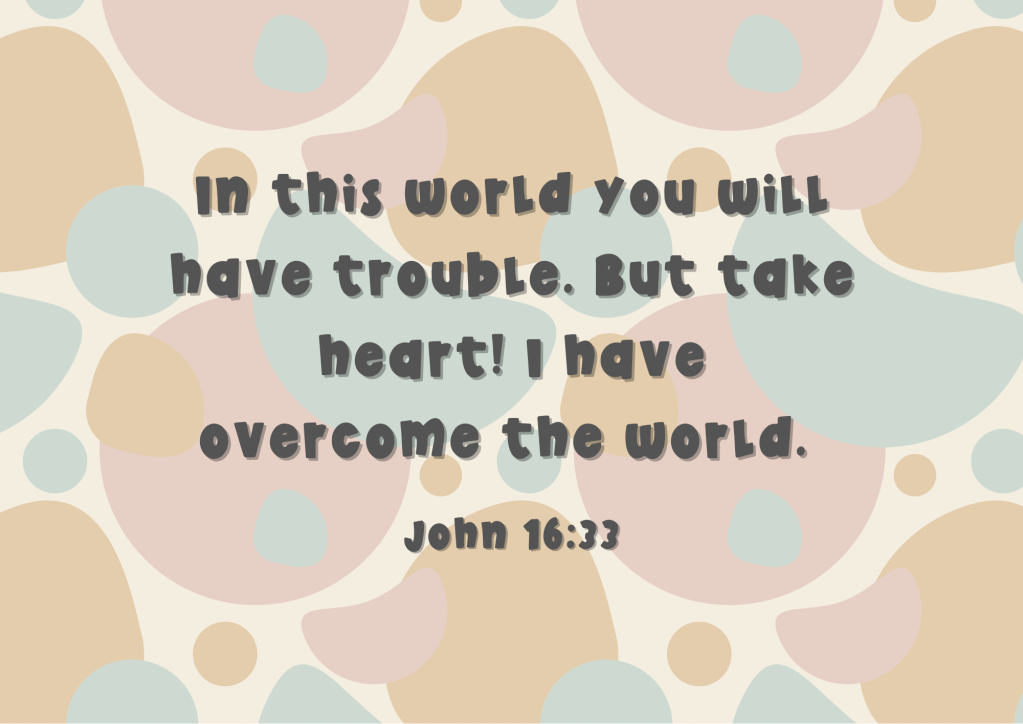
It’s that mindset that I want to challenge today. The truth is, just because we have faith doesn’t mean we won’t face challenges. Jesus himself said, “In this world you will have trouble. But take heart! I have overcome the world.” (John 16:33) That verse doesn’t say “If you have enough faith, you won’t face difficulty.” It says that, even in the midst of difficulty, we can take heart because Jesus has overcome it all. He’s with us in our pain, our struggles, and our doubts.

And that’s something that’s been something so powerful in my own journey: understanding that God is with me in the struggle. He doesn’t leave us when we’re struggling mentally or emotionally. I’ve learned that struggling with mental health doesn’t mean we’re failing God or our faith – it means we’re human. And God knows what it’s like to be human. He became human in Jesus, and he understands our pain in a way that no one else can.

I’ve also found it hard to accept that, just because I’ve had therapy and take medication, it doesn’t mean I’m not strong enough. But, faith is not about denying reality or pretending that everything is okay. Faith is about trusting God through the hard stuff – through the things we can’t fix on our own. Faith is not a magic fix for our pain; it’s a relationship with a God who holds us, even when we’re at our lowest.

If you’re struggling with mental health today – whether that’s anxiety, depression, stress, or anything else – I want you to hear this: It’s okay not to be okay. Your mental health is just as important as your physical health. And God sees you. He cares about what you’re going through. And he wants to help you through it.

Another scripture that has brought me so much comfort in times of struggle is Philippians 4:6-7. It says “Do not be anxious about anything, but in every situation, by prayer or petition, with thanksgiving, present your requests to God. And the peace of God, which transcends all understanding, will guard your hearts and minds in Christ Jesus.”

Now, I know that verses like this can sometimes feel like a ‘quick fix’ that doesn’t address the depth of what we’re going through. But I want to highlight that the peace of God doesn’t mean the absence of struggle. It means that, in the midst of struggle, God’s peace can still hold us. It’s not about getting rid of the anxiety or pain, but about experiencing peace through it.

So, my takeaway message if this: If you’re struggling with your mental health, it doesn’t mean that you’re weak in faith, and it doesn’t mean that you’re doing something wrong. In fact, it might mean that you’re being brave enough to face something difficult – and that’s something that God honours. Don’t let shame or guilt keep you from getting the help you need. Whether it’s therapy, medication, or a supportive community, there is no shame in seeking help. Faith is about trusting God in the journey, not denying that we’re needing help along the way.

So, as I finish, I want to encourage you to take a moment to reflect on how God might be inviting you to trust him with your mental health. What steps can you take to care for yourself, body, mind, and spirit? Maybe it’s something small, like acknowledging your struggles or reaching out for help.

All my love,

Anna x

Not Your Time

Content Warning: This post talks about suicide. Although no details are given please be mindful of this and don’t read on if this is something that might be triggering for you!

Have you ever had someone say to you, “It’s clearly not your time,” after a suicide attempt? If you have, you probably know how cliche it sounds. Those words can feel empty, as though they’re meant to close a conversation rather than open one. Yet, as much as I’ve resisted the phrase, I can’t deny the weight it holds in my own life. After surviving multiple attempts to die – despite every intention to leave this world – I’ve been forced to confront the possibility that those words might carry a truth I hadn’t been willing to see.

I’ve tried. Many times. In moments of despair, I’ve done everything within my power to end the pain. And every single time, something has stopped in from happening. Maybe it was an intervention of a friend, the police or hospital staff, or a twist of fate that kept me alive. Maybe it was sheer luck, or as I’ve come to consider more and more, maybe it was because it wasn’t part of the plan that God has for my life.

The idea that survival is part of a greater plan is as difficult to accept as it is to dismiss. If I believe that God has a purpose for my life – and some part of me does – then surviving when I was ready to die suggests that my story isn’t over yet. If my time had come, wouldn’t I have succeeded? Wouldn’t I finally have found that escape?

But believing in that purpose doesn’t make the pain vanish. If anything, it complicates things. I’ve found myself asking why God would keep me here, struggling, when I was so ready to let go. What possible reason could justify the agony that led me to those moments in the first place? It’s a question I don’t have an answer to – at least, not yet.

If you’re reading this, maybe you’ve asked yourself similar questions. Maybe you’ve also faced moments when death seemed like the only way out. And maybe, like me, you’re still here, unsure of why. Here’s the conclusion I’ve started to reach: survival might not feel like a gift in the moment, but it’s an invitation to keep going. To keep searching. To keep asking what’s next.

When I think about the times I’ve survived, I realise that those moments weren’t random. They were filled with small interventions – a text from a friend, a hug from a family member that I so desperately needed, the police turning up at exactly the right moment to stop me doing something I wouldn’t be able to undo. Those moments weren’t the answers to all my questions, but they were signposts pointing me toward something bigger.

Wrestling with God’s Plan

If you believe, as I do, that God has a plan for each of us, then the idea that “it’s not your time” takes on a heavier, more significant meaning. If God has kept me here through all of this, then it would stand to reason that my time to leave this world is not now – because if it were, I would be gone. Period.

But it’s hard to reconcile the pain and hopelessness that drive someone to attempt suicide with the concept of a loving God who is guiding everything. It can feel cruel. Why keep me here, God, if it hurts this much? Why not let me go when I was so ready, so certain?

I don’t know exactly what God’s plan for me looks like. But I’ve started to think that surviving is part of it. Being here, despite everything, is part of it. And maybe writing this, sharing this, is part of it too.

“It’s still clearly not your time” still sounds cliche to me. It probably always will. But maybe the reason it’s such a persistent phrase is because there’s a deep truth buried in it. If you’ve survived something you didn’t think you could survive, it’s worth considering that there might be a reason for that. Not in a shallow, sugar-coated way, but in a profound, weighty way that calls up to look deeper into our lives and our purpose.

So here I am, still trying to figure it all out. Still asking questions. Still frustrated. But also still here. And if you’re reading this, you’re still here too. Maybe that’s worth something. Maybe that’s worth everything.

‘But he said to me, “My grace is sufficient for you, for my power is made perfect in weakness.” Therefore I will boast all the more gladly about my weaknesses, so that Christ’s power may rest on me.” – 2 Corinthians 12:9

All my love,

Anna x