Mourning the Life You Expected

I’ve written about the grief that accompanies chronic illness before, but it’s a topic that I often come back to because it is something that has been so prevalent in my life.
Living with chronic illness often comes with a deep sense of loss. It isn’t just the physical symptoms that affect your day-to-day life, but also the realisation that the life you imagined for yourself might never come to fruition. This feeling of loss can manifest as grief, a complex emotional process that many people with chronic illness experience.

Grief isn’t just something that is limited to the death of a loved one. People often grieve the loss of:

Physical abilities – the things you once took for granted like running, dancing, walking, might now feel or become impossible.

Independence – it’s hard when you have to suddenly rely on other people for help doing tasks that you would have previously handled independently with no problems. This is something that can feel incredibly vulnerable.

Future plans – you might have to give up on career goals, travel plans, or family aspirations, or at the very least, adjust your expectations of what you can realistically manage.

Sense of identity – chronic illness can force you to redefine who you are and how you see yourself. This is something that I have struggled with a lot – who am I without the things that I can no longer do. Who am I if I’m not studying or working?

Grief doesn’t follow a linear pattern at all. There are stages of grief that people go through but the order and time it takes varies massively from person to person. The five stages that people are said to experience are as follows:

Denial – “This can’t be happening to me.” You might ignore symptoms or resist a diagnosis.

Anger – “Why me?” It is completely natural to feel frustration and resentment about your situation!

Bargaining – “If I do everything that the doctors are telling me to do, maybe I’ll get better.” This stage also often involves clinging on to the possibility of a cure or treatment that will make life bearable.

Depression – “What’s the point?” Sadness and hopelessness can feel incredibly overwhelming.

Acceptance – “This is my reality but it doesn’t have to define me.” Accepting your situation doesn’t mean that you like your situation, rather that you are finding ways to move forward despite your diagnosis and struggles.

So, what can you do help cope with these feelings of grief?

You should allow yourself to feel your feelings. Don’t try to bury them because this isn’t going to help and will likely make things more difficult in the long run. It can also help to connect with other people who understand what life with chronic illness is like – I’m very lucky to have found communities on Facebook and Instagram that have allowed me to meet other people in similar situations to myself.

Therapy can also be a very helpful tool. I have been seeing a counsellor for 4 years and she has been my lifeline, offering me a safe space to explore my feelings around my illness. Through therapy I have learned how to be more compassionate towards myself and to respect my body’s limitations. I now respond with kindness when I’m having bad days as I’ve learned that punishing myself is not going to be beneficial.

Grief doesn’t mean giving up – it means making space to acknowledge your losses but also the new opportunities that might arise as a result. Chronic illness may alter your life dramatically, yes, but it doesn’t erase who you are as a person. And it doesn’t have to get rid of your potential for growth, connection, and happiness.

All my love,

Anna x

Post Your Pill – Why There is No Shame in Taking Psychiatric Medication

Three years ago Dr Alex George decided to post a picture of himself holding the medication that he takes for his mental health. The idea behind it was to challenge the stigma around medication and mental health. When he first started taking medication he felt ashamed – a feeling that so many people have felt at the prospect of needing medication to help manage their mental health. Since then thousands and thousands of people have also joined in, posting pictures of their medication on the 1st of every month in an attempt to help remove the shame and stigma associated with meds.

I used to think that taking psychiatric medication was something to be ashamed of. I worried it made me ‘weak’ or demonstrated that I wasn’t trying hard enough. There was a part of me that believed that I should simply ‘push through’ and try to manage on my own. But here’s the truth: there is NO shame in taking medication for your mental health. Those thoughts that I had were planted by a society that still stigmatises mental health struggles and the tools we use to manage them.

When someone needs glasses to see clearly, insulin to manage diabetes or an inhaler because they have asthma, there is no hesitation. We simply accept that they need medication to help. So why is there so much stigma around mental health medication? Your brain is just as much a part of your body as any other organ and, sometimes, you need extra help.

Psychiatric medication doesn’t change who you are as a person. It doesn’t erase your personality or take away your emotions. It simply helps to create space for you to be more yourself.

Medication for mental health is just a different part of the ‘toolkit’ you can use to manage your mental health, just like talking therapy is a different way to benefit yourself. It doesn’t get rid of your struggles or do the work for you, but it does help make things more manageable. It can clear the fog long enough for you to engage in support like therapy and to help you implement the tools that you need in your day-to-day life. For some people it is medication that can get you to a point where you can get out of bed in the morning. For others it helps to lessen the anxiety that you feel or to manage unwanted thoughts and feelings.

It’s not a perfect process by any stretch of the imagination either. Finding the right medication and dosage can take a long time – I tried 11 different medications at various doses and for varying lengths of time before landing on a combination that works for me. I still struggle, and it doesn’t really help lift my mood much, but it definitely helps prevent me from hitting rock bottom. And choosing to explore the option of medication and being open to the possibility of taking meds isn’t a failure, it’s another way of saying “I deserve to feel better, and I am willing to try whatever it takes.”

Meds don’t come without potential complications, either. They can make things worse to begin with, and they take a while to fully kick in. There are also potential side effects to contend with (and sometimes additional meds needed to combat various side effects) or withdrawals if you are coming off a medication you’ve taken for a long time. But by acknowledging that you deserve to feel better you are deciding that your mental health matters and that you are wanting to take care of yourself. This isn’t a sign of weakness – it’s a sign of incredible strength.

If you’re on medication for your mental health, considering it, or simply curious about what it could do for you, remember this: there is no right or wrong way to look after your mental health. Some people find healing in therapy, some by exercising, some by taking medication. Often it is a combination of different approaches that can make the most difference. And if you’re feeling hesitant or alone because of the stigma, know that you are not alone. Here is what I wish I could tell my younger self:

Taking care of your mental health – however that may be – is an act of love. You are not weak. You are not broken. You are brave, resilient, and deserving of every tool available to help you live the life you want.

So, let’s keep talking about this. Let’s challenge the stigma and remind each other that there’s no shame in doing what you need to feel better. Because you – and your mental health – are worth it.

All my love,

Anna x

Why I hate New Year’s Resolutions

Every year, millions of people readily come up with New Year’s resolutions and are filled with anticipation that this might be the year that we eat better, exercise more, complete a project or achieve a life goal. And every year, by February (or let’s be real – by mid-January) planners are discarded, gyms are emptier and diets have gone out the window. Sound familiar? That’s because, for the most part, New Year’s resolutions are a load of crap.

They are built on a false premise – the idea behind New Year’s resolutions is simple: January 1st is some kind of magical reset that will transform you into a better version of yourself. But here’s the truth: change doesn’t care about the date on the calendar. There isn’t anything that special about the first day of the year. Waiting for a specific date to work towards achieving a positive goal or habit is just procrastination wearing a festive hat.

They set you up for failure – most resolutions are vague and unrealistic. They might sound nice, but without a concrete plan or measurable milestones, they’re destined to fail. When you inevitably fall short, you’re left feeling guilty and frustrated – not exactly the motivation you’re wanting, right?!

They’re all or nothing – resolutions are framed as black or white, there is no grey area. Either you’re hitting your daily step goal or calorie ideal or you’re failing. This is a recipe for disaster because life is messy and slip-ups are inevitable. It is not a reason to quit altogether.

They ignore the power of small, steady change – real, lasting change doesn’t happen in giant leaps; it happens in the small, consistent steps. Small wins help you to build momentum and, in turn, motivation. New Year’s resolutions are idealistic and built on the idea of instant transformation.

They’re driven by external pressure – lets be honest: how many resolutions you come up with are things you actually want vs things you think you should want. Unsurprisingly, when you make resolutions that are driven by what you think you should want, they become easy to abandon, and therefore fuel the feelings of guilt and failure.

They are a marketing ploy – New Year’s resolutions are a goldmine for companies looking to sell you something. Gym memberships, subscriptions to diet plans, apps that promise you productivity – they are capitalising on your hopeful (and usually short-lived) commitment to self-improvement. Instead of falling for the hype and buying in to something you don’t really want or need, ask yourself: do I really need this or am I falling for a clever sales pitch?

So, what’s the alternative?

Ditch the pressure-filled annual ritual and focus on a more sustainable approach to change – focus on habits and taking small steps each day, remember that you can start at any time because the best time to start is always now. Be compassionate and gentle with yourself and remind yourself that you can adjust your goals and plans as you need to. And, finally, make sure that your goals align with your values – you’re much more likely to keep motivated to achieve your goals if they fit who you are as a person!

The bottom line is this: you don’t need an arbitrary date or big resolution to grow or succeed. Real change happens gradually and consistently. I hope that the next year is the year where you learn to focus on building a life that feels good no matter what day of the year it is.

See you all in 2025!

All my love,

Anna x

Not Your Time

Content Warning: This post talks about suicide. Although no details are given please be mindful of this and don’t read on if this is something that might be triggering for you!

Have you ever had someone say to you, “It’s clearly not your time,” after a suicide attempt? If you have, you probably know how cliche it sounds. Those words can feel empty, as though they’re meant to close a conversation rather than open one. Yet, as much as I’ve resisted the phrase, I can’t deny the weight it holds in my own life. After surviving multiple attempts to die – despite every intention to leave this world – I’ve been forced to confront the possibility that those words might carry a truth I hadn’t been willing to see.

I’ve tried. Many times. In moments of despair, I’ve done everything within my power to end the pain. And every single time, something has stopped in from happening. Maybe it was an intervention of a friend, the police or hospital staff, or a twist of fate that kept me alive. Maybe it was sheer luck, or as I’ve come to consider more and more, maybe it was because it wasn’t part of the plan that God has for my life.

The idea that survival is part of a greater plan is as difficult to accept as it is to dismiss. If I believe that God has a purpose for my life – and some part of me does – then surviving when I was ready to die suggests that my story isn’t over yet. If my time had come, wouldn’t I have succeeded? Wouldn’t I finally have found that escape?

But believing in that purpose doesn’t make the pain vanish. If anything, it complicates things. I’ve found myself asking why God would keep me here, struggling, when I was so ready to let go. What possible reason could justify the agony that led me to those moments in the first place? It’s a question I don’t have an answer to – at least, not yet.

If you’re reading this, maybe you’ve asked yourself similar questions. Maybe you’ve also faced moments when death seemed like the only way out. And maybe, like me, you’re still here, unsure of why. Here’s the conclusion I’ve started to reach: survival might not feel like a gift in the moment, but it’s an invitation to keep going. To keep searching. To keep asking what’s next.

When I think about the times I’ve survived, I realise that those moments weren’t random. They were filled with small interventions – a text from a friend, a hug from a family member that I so desperately needed, the police turning up at exactly the right moment to stop me doing something I wouldn’t be able to undo. Those moments weren’t the answers to all my questions, but they were signposts pointing me toward something bigger.

Wrestling with God’s Plan

If you believe, as I do, that God has a plan for each of us, then the idea that “it’s not your time” takes on a heavier, more significant meaning. If God has kept me here through all of this, then it would stand to reason that my time to leave this world is not now – because if it were, I would be gone. Period.

But it’s hard to reconcile the pain and hopelessness that drive someone to attempt suicide with the concept of a loving God who is guiding everything. It can feel cruel. Why keep me here, God, if it hurts this much? Why not let me go when I was so ready, so certain?

I don’t know exactly what God’s plan for me looks like. But I’ve started to think that surviving is part of it. Being here, despite everything, is part of it. And maybe writing this, sharing this, is part of it too.

“It’s still clearly not your time” still sounds cliche to me. It probably always will. But maybe the reason it’s such a persistent phrase is because there’s a deep truth buried in it. If you’ve survived something you didn’t think you could survive, it’s worth considering that there might be a reason for that. Not in a shallow, sugar-coated way, but in a profound, weighty way that calls up to look deeper into our lives and our purpose.

So here I am, still trying to figure it all out. Still asking questions. Still frustrated. But also still here. And if you’re reading this, you’re still here too. Maybe that’s worth something. Maybe that’s worth everything.

‘But he said to me, “My grace is sufficient for you, for my power is made perfect in weakness.” Therefore I will boast all the more gladly about my weaknesses, so that Christ’s power may rest on me.” – 2 Corinthians 12:9

All my love,

Anna x

Ella’s Sepsis Story

If there’s one thing you read in its entirety today, please let it be this.

It been 2 year ago now since I knocked on death’s door! I went from being at a farm swap one day, to dying the next. It wasn’t a rare medical condition that brought me from being a healthy woman to a dying one either. It just hit hard, it hit fast and it would turn my life upside down.

In August of 2022 I had sepsis. And then in October of 2023 it came back. The goal of 2024 is to not get sepsis!

Before I had sepsis, I knew that sepsis was your body’s reaction to infection. I just thought old people got it or those with poor health. I didn’t know people like me(or that even my children) could get it so quickly and I didn’t know that sepsis had long term health affects. I was pretty uneducated about what sepsis was.

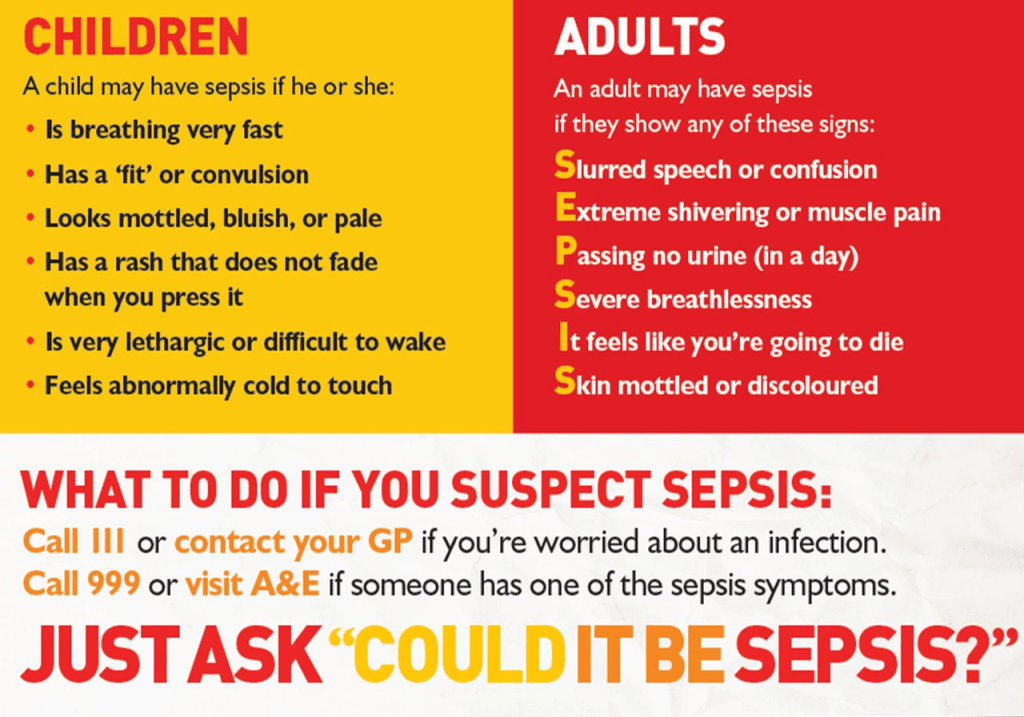
And so it’s become important to me to share what sepsis is, to tell you how to recognize signs of it and to tell you what post-sepsis syndrome is, in hopes that if you are sick you don’t wait to seek medical attention.

Sepsis is the body’s extreme response to an infection. If you don’t get treatment for it, it can lead to organ failure, tissue damage and death.

Symptoms of sepsis are not specific. They can vary from person to person. Initially my blood pressure was low and I had change in mental clarity… my mental state was the most drastic actually. So much so that the hospital ER staff believed I was high on narcotics and was treating me as such. It wasn’t until the hospital made contact with my husband and my best friend arrived at the ER that they were able to ensure the hospital I wasn’t a drug addict and that something else was wrong. And it was! I was finally given a urine drug screen and passed, but the long wait in the ER and being treated as just another addict had delayed much needed treatment and my sepsis turned into septic shock. My best friend saved my life that day.

I spiraled quickly… my blood pressure was low, my respiratory rates were high, I had a fever, I was hallucinating, I was shivering, I lost control of my bladder functions, I felt nauseous. I felt absolutely horrible.

Having sepsis led to my long admittance to the hospital. If I had stayed home, I wouldn’t have made it. If the hospital had delayed longer, I wouldn’t have made it. When people don’t get treatment, sepsis is a leading cause of death. Sepsis ranks higher than breast cancer, lung cancer, and heart attacks. It’s serious stuff. Sepsis can kill an affected person in as little as 12 hours and now that I’ve “been there, done that”, I can testify that this is absolutely true. I was feeling pretty deathly pretty rapidly.

Sepsis is treated with a strict antibiotic regimen. The underlying cause of sepsis or the original infection isn’t always known. It wasn’t ever clearly determined what caused me to get sick. They just have theories.

When I was discharged from the hospital I left knowing I’d be out of work for a bit, taking time to feel better, get rested, etc. But as the days grew to weeks, I wasn’t getting better. I found myself lost(literally), easily confused, at a loss for words, extremely tired, and unable to do tasks I once could. I would wake up and be disoriented to where I was. I’d sit in the house and not know what I was supposed to be doing. I’d try to do simple tasks like pickup dinner at the store and then completely forget why I was there. I would see people and they would act like we knew each other but I had no memory of them. Jason would tell me who they were but it’s like they never existed. I’d relearn people, names, and events. I would later find out that I had post-sepsis syndrome.

Post-sepsis syndrome affects 50% of sepsis survivors. Symptoms vary from psychological to physical effects. My short term memory was heavily impacted as was my cognitive functioning, similar to that of a traumatic brain injury. I had extreme fatigue and chest pains. My once normal heart now had tachycardia.

Post sepsis has required me to take medications just to stay awake during the day and to stimulate my brain. It’s changed my heart functioning and I take medications to keep it beating the right way. It’s made me forget some moments I desperately want to remember. It’s made simple memory tasks into harder ones. It’s made me rely on others to help do tasks I once could easily do. It’s enrolled me in rehab where we practiced skills to help my injured brain.

Now I do things on my speed and with tons of support from my husband and kids.

If you say “wow! I didn’t know!” It’s because I have the best support system someone could ask for. You don’t see me fail because of them. I succeed because they are behind me filling in the gaps.

I don’t share this because I want prayers or good vibes. I don’t want sympathy. On my two year almost dying anniversary, I want you to take sepsis seriously. Very seriously. I want you to go the doctor when you have an infection. I want you to take 5 mins today and to Google sepsis and read about all the signs and symptoms of sepsis.

I want you to be healthy. ❤️

Behind Closed Doors

A question I’ve been asked a lot before is ‘what is life like on a psychiatric ward?’ and I don’t think there’s a description I can give that fully sums it up. It changes from ward to ward, patient group to patient group and things like ward dynamics, staff, type of ward and outside influences can change how things are dramatically. For example, the ward I’m currently on is in the process of being completely split into a male ward and a female ward so there is a lot of building work going on. This means that it’s loud, busy and often overwhelming. It has definitely impacted how this admission has been compared to when I was here 4 years ago. But I’ll try and describe what life can be like on wards – this is purely based on my experiences as a patient (and former staff member – I used to work as a HCA at a Priory hospital so I can comment based on that experience too). It’s also important to note that I am referring to acute wards (the most common type of ward) as this is the only kind of ward I have experience of – I am not talking about PICU, secure services, rehabilitation wards etc which all have very different presentations too.

This is fairly typical of modern bedrooms on psychiatric wards – obviously not all wards will look like this, but it was a picture that seems fairly in line with my experience of wards.

Thinking about psychiatric wards can feel like you step into a world that is covered in a veil of mystery, yet also stigma. Patients are kept behind locked doors and, unless you are admitted yourself, or are visiting someone on a ward, things are neatly hidden away. That is, unless a patient absconds, but that’s a whole other kettle of fish and something I’ll leave for another day. So what is life like behind these closed doors? Psychiatric wards serve as a safe space for individuals experiencing mental health crisis and offer a degree of support and treatment for a wide range of mental health conditions. The experience of life on a ward varies hugely from patient to patient, especially as we are all so unique and are all presenting in different ways, yet there are some common threads that tie the experience together.

I think one of the biggest misconceptions about psychiatric wards is that you go in unwell and come out better. On NHS wards in particular there is a big absence of therapeutic work available to patients as this kind of long-term work typically comes in the community (or rehabilitation wards such as those that specialise in trauma therapy or DBT). It’s not that common for wards to have regular therapeutic interventions from psychologists, although in some cases this does happen. I, for example, have just been offered 4/5 weeks of weekly sessions with a psychologist to complete a formulation that will hopefully help to prepare me for discharge. However, the therapy that I really need – trauma work – will come when I am in the community and stable enough to fully engage in it. Patients will typically be discharged once they have stabilised to a degree that they are no longer in acute crisis, but this does not mean that they are well, or even that they are stable by ‘normal’ standards – they are stable enough to be discharged.

Often there is an activities programme put together by the activity coordinators and occupational therapists that work on the ward and this can provide a welcome distraction from the mundane life that patients are forced to experience. This can include things like film nights, cooking sessions, baking, playing games, having coffee mornings, having access to an art room and visits from PAT dogs (I did, of course, save the best until last!) They may also offer things like mindfulness sessions and individual sessions with OT’s to work on individual goals. Programmes like this do help as they engage patients to a degree and get them used to regularly engaging in groups, as well as mixing with other patients (something I’ll come to in a minute). Engaging in groups also shows the MDT that you are working with staff and will work in your favour when it comes to things like requesting leave and, eventually, discharge.

One of the ‘nicest’ aspects of life on a psychiatric ward is the opportunity to make connections with other patients – after all, you are spending all day, every day in the same, fairly confined, space and so you do often get to know each other quite quickly. This isn’t always the case, though, as it does depend on the patient group at the time and how well you ‘gel’ with other patients. However, when connections are forged, they are often deep and meaningful. After all, you understand the difficulties of being in crisis and what life is like with mental illness, may have similar diagnoses, and can empathise with the difficulties of being stuck on a ward, shut away from the outside world. There’s also the opportunity for peer support, as patients can share their experiences and give advice based on situations they have found themselves in – I know I find it much more reassuring when I’m hearing things from someone who truly understands what my life can be like as there is that empathy underlying the discussions.

I was actually having a discussion with a patient the other day. We are fairly similar in age which is always nice, and seem to have a good relationship despite only knowing each other for a matter of days. We were sat in the quiet lounge (trying to escape the hectic nature of the ward at the moment – building work and loud patients aren’t always the best combination for two individuals who need to have quiet time!) and got chatting about our lives and how we ended up on the ward. And as each of us spoke, we found it really easy to slip in different pieces of advice, as well as stories from our lives to hopefully encourage the other. This isn’t always how things happen on wards, however, but it’s a nice bonus when it does!

Something that I think is probably fairly common, yet also not, across wards is the sense of rigidity and routine – it can often feel like there is no routine or structure on a ward, and whilst that can be the case at times, when you take a step back and look at the day as a whole you will find that there is actually a lot of routine and structure. Medications are given at the same time (roughly) daily, meals are always at the same time, groups tend to happen at the same time each week and you have your ward round at the same time weekly as well. When you aren’t able to engage in groups or they aren’t available it definitely feels like there is no structure at all – you seem to aimlessly float around, maybe sitting in the communal area for a change of scenery, but certainly not feeling like there is any semblance of structure to your day. But some of this does give patients a feeling of predictability and order – they know their meds are coming or that lunch is coming up – in a world that can feel so unpredictable and messy.

I could probably go on and on with stories from my admissions, comparing different wards and just generally rambling, but  I’ll draw to a close here. Overall, life behind the closed doors of a psychiatric ward is a complex, interconnected web with so many different threads that draw together. It can vary so much from place to place or time to time but I think that the overall aim is for wards to be places of safety for people experiencing crisis where they can stabilise to a degree before returning to ‘normal’ life to continue their recovery. I hope that by talking about the reality of life on a psychiatric ward it can do a few things: dispel some of the myths and misconceptions that people might have, shed some light on what life is really like whilst an inpatient on an acute adult psychiatric ward, and also foster greater empathy, compassion and support for those who are struggling with their mental health. Whilst we have made great improvements in the understanding and acceptance of mental health in recent years, there is still a lot of stigma that needs to be removed and it is talking that will help to lessen this stigma even more. 

All my love,

Anna x